A Decennial History of Jersey City with Demographics, Architecture, and Economics (1630s-2020s)
Jersey City Dramatic Rise
A Decennial History of Jersey City (1630s–2020s)
- Demographics & Economics: Population and income statistics from the 19th century onwards rely on U.S. Census Data, Wikipedia's regional archives, and projections from the World Population Review. Pre-1840 data are historical estimates for the Pavonia/Bergen settlements. Income figures (adjusted to estimated 2026 USD) before the 20th century represent a "purchasing-power equivalent" to contextualize historical barter/agrarian economies.
- Paint & Architecture: Details regarding historic paints (milk paints, linseed oil, calcimine, early lead-based formulas) and popular color palettes are informed by the National Park Service Preservation Briefs and regional historic structure plans.
- Historical Timeline: Institutional timelines and milestone references are contextualized by local archives, including New Jersey City University's historical records.
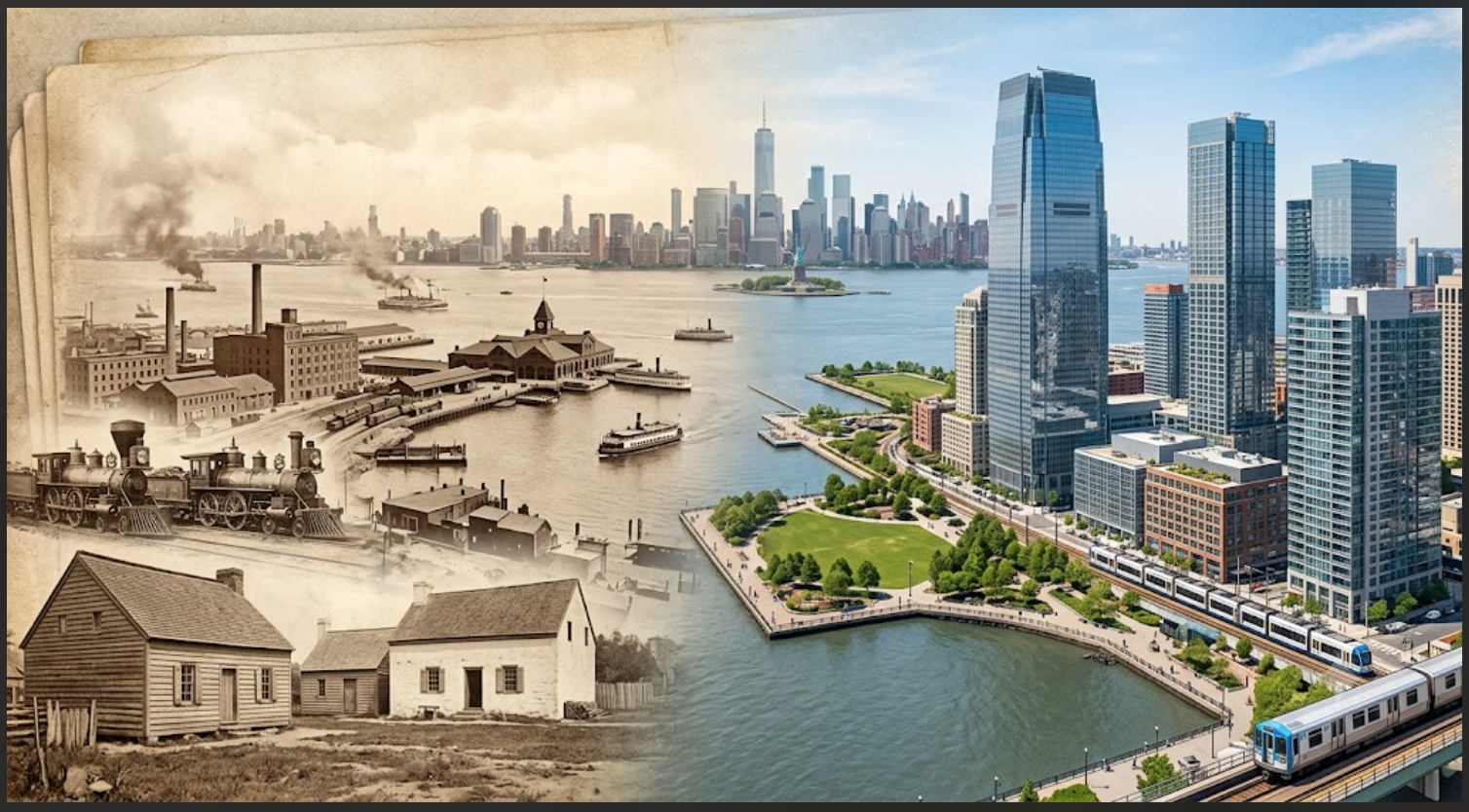
Jersey City boasts a rich, multi-layered history that spans nearly four centuries. From its origins as a colonial Dutch settlement to its modern iteration as a towering financial metropolis, its architecture, colors, and demographics have constantly evolved. Below is a decade-by-decade breakdown detailing the biggest historical events, population sizes, building counts, architectural paint trends, and estimated equivalent incomes.
1. The 17th Century: New Netherland and English Conquest
1630s: The First Settlement (1630)
Biggest Event: On November 22, 1630, Michael Reyniersz Pauw received a land grant for "Pavonia." This marked the first European settlement in the area. Pauw was an absentee landlord, and Cornelius Van Vorst later established one of the first permanent residences.
| Population | Buildings | Paint Used | Popular Colors | Est. Avg Income (2026 USD) |
|---|---|---|---|---|
| < 30 colonists | < 10 timber frames | Unpainted timber; early whitewash (lime/water/salt). | Whitewash Weathered Wood |
~$15,000 (Subsistence) |
1640s: Kieft's War and the Pavonia Massacre (1643)
Biggest Event: Dutch Governor Willem Kieft ordered a brutal attack on Lenni Lenape Native Americans seeking refuge at Pavonia. The resulting "Pavonia Massacre" ignited Kieft's War, forcing surviving colonists to abandon the settlement.
| Population | Buildings | Paint Used | Popular Colors | Est. Avg Income (2026 USD) |
|---|---|---|---|---|
| Near 0 (Abandoned) | Mostly destroyed | Unpainted timber and daub. | Charred Wood Earth Tones |
N/A (War period) |
1650s: The Peach Tree War and Stuyvesant's Repurchase (1655–1658)
Biggest Event: After the 1655 Peach Tree War wiped out the area again, Dutch Director-General Peter Stuyvesant formally "re-purchased" the lands of Pavonia from the Munsee in 1658, paving the way for a permanent settlement.
| Population | Buildings | Paint Used | Popular Colors | Est. Avg Income (2026 USD) |
|---|---|---|---|---|
| ~50-100 | ~15-20 outposts | Basic milk paint and whitewash. | Reddish-Brown | ~$15,500 |
1660s: The Establishment of Bergen (1660)
Biggest Event: The fortified village of Bergen (located in present-day Journal Square) was officially chartered, becoming the first permanent European settlement and civil government in New Jersey.
| Population | Buildings | Paint Used | Popular Colors | Est. Avg Income (2026 USD) |
|---|---|---|---|---|
| ~150-200 | ~30-40 enclosed structures | Milk paint, early linseed oil sealants. | Yellow Ochre Barn Red |
~$16,000 |
1670s: The Final Transition to English Rule (1674)
Biggest Event: Following a brief Dutch recapture, the Treaty of Westminster permanently handed New Jersey back to the English, solidifying English common law over the old Dutch agrarian systems.
| Population | Buildings | Paint Used | Popular Colors | Est. Avg Income (2026 USD) |
|---|---|---|---|---|
| ~250 | ~50 farmhouses | Locally sourced milk paint & linseed oil. | Grey Timber Red Oxide |
~$16,500 |
1680s: The Formation of Bergen County (1683)
Biggest Event: The provincial legislature established Bergen County. The village of Bergen served as the seat of government, managing the territory between the Hudson and Hackensack Rivers.
| Population | Buildings | Paint Used | Popular Colors | Est. Avg Income (2026 USD) |
|---|---|---|---|---|
| ~350 | ~75 structures | Linseed oil paints mixed on-site with ground natural pigments. | Raw Umber | ~$17,000 |
1690s: Agrarian Expansion
Biggest Event: With political stability achieved, agrarian farmsteads expanded outward. The area transitioned into a vital agricultural supplier for the rapidly growing city of New York.
| Population | Buildings | Paint Used | Popular Colors | Est. Avg Income (2026 USD) |
|---|---|---|---|---|
| ~450 | ~100 farmhouses | Linseed oil paint with basic lead pigments. | Spanish Brown Pale Grey |
~$18,000 |
2. The 18th Century: Royal Colony to the Crossroads of the Revolution
1700s: Unification as a Royal Colony (1702)
Biggest Event: Queen Anne united the separate proprietary colonies into a single Royal Colony, streaming governance and deeply integrating Bergen into the wider British mercantile system.
| Population | Buildings | Paint Used | Popular Colors | Est. Avg Income (2026 USD) |
|---|---|---|---|---|
| ~600 | ~120 structures | Imported white lead paint (sparingly). | Dull Whites | ~$18,500 |
1710s: The Expansion of Overland Routes
Biggest Event: Under Governor Robert Hunter, early colonial road networks formalized, connecting the isolated Bergen peninsula more reliably to the interior across the Hackensack meadows.
| Population | Buildings | Paint Used | Popular Colors | Est. Avg Income (2026 USD) |
|---|---|---|---|---|
| ~750 | ~150 structures | Oil-based paints for wealthy homes. | Prussian Blue Stone Gray |
~$19,000 |
1720s: The Ascendancy of Paulus Hook
Biggest Event: The Van Vorst landholdings at Paulus Hook became recognized as the superior geographic point for ferrying passengers to Manhattan, creating a major mercantile chokepoint.
| Population | Buildings | Paint Used | Popular Colors | Est. Avg Income (2026 USD) |
|---|---|---|---|---|
| ~900 | ~180 structures | Linseed oil and lead, hand-mixed. | Oyster Grey Dove Grey |
~$20,000 |
1730s: Surveying and Local Roadhouses
Biggest Event: As Hudson River traffic increased, the 1730s saw the establishment of early roadhouses and taverns near the ferry landings at Paulus Hook and Communipaw.
| Population | Buildings | Paint Used | Popular Colors | Est. Avg Income (2026 USD) |
|---|---|---|---|---|
| ~1,100 | ~220 buildings | Lead-based oil paints with natural tinting. | Neutral Drabs Pale Yellows |
~$21,000 |
1740s: Integration into the Regional Economy
Biggest Event: Wagon traffic into Paulus Hook steadily increased as New Jersey farmers funneled their produce to the New York market. The settlement saw expanded barns and ferry infrastructure.
| Population | Buildings | Paint Used | Popular Colors | Est. Avg Income (2026 USD) |
|---|---|---|---|---|
| ~1,300 | ~260 buildings | Standardized colonial oil paints. | Barn Red Grey-Blue |
~$22,000 |
1750s: Pre-Revolutionary Prosperity
Biggest Event: The Bergen area served as a critical logistical pipeline, supplying British troops and the city of New York with livestock, grain, and timber during the French and Indian War.
| Population | Buildings | Paint Used | Popular Colors | Est. Avg Income (2026 USD) |
|---|---|---|---|---|
| ~1,500 | ~300 structures | Improved oil paints with Verdigris pigments. | Creamy Whites Dark Green |
~$24,000 |
1760s: The "Flying Machine" Stagecoach (1764)
Biggest Event: In 1764, the region’s role as a transportation hub was cemented with the establishment of the first regular passenger stagecoach route, the "Flying Machine," terminating at Paulus Hook.
| Population | Buildings | Paint Used | Popular Colors | Est. Avg Income (2026 USD) |
|---|---|---|---|---|
| ~1,800 | ~350 buildings | Hand-mixed oil paints with imported pigments. | Light Stone Pale Yellow |
~$26,000 |
1770s: The Battle of Paulus Hook (1779)
Biggest Event: During the American Revolution, the British heavily fortified Paulus Hook. In 1779, American Major "Light Horse Harry" Lee led a daring raid on the fort, boosting Continental morale.
| Population | Buildings | Paint Used | Popular Colors | Est. Avg Income (2026 USD) |
|---|---|---|---|---|
| ~1,500 (Wartime) | ~300 (Many damaged) | Maintenance of old coats (scarcity). | Faded Yellows | ~$15,000 (War disruption) |
1780s: Post-War Recovery (1783)
Biggest Event: The 1780s were marked by residents returning to rebuild looted farms, destroyed infrastructure, and the vital ferry networks following the British evacuation of New York.
| Population | Buildings | Paint Used | Popular Colors | Est. Avg Income (2026 USD) |
|---|---|---|---|---|
| ~1,800 | ~350 structures | Federal era oil paints, linseed oil base. | Federal Cream Black Green |
~$22,000 |
1790s: Preparation for Urbanization
Biggest Event: Visionary figures like Alexander Hamilton recognized the potential of the Hudson River's western bank. Initial speculative land transfers occurred to replace the agrarian landscape.
| Population | Buildings | Paint Used | Popular Colors | Est. Avg Income (2026 USD) |
|---|---|---|---|---|
| ~2,200 | ~400 structures | Early commercial oil paints. | Pale Peach Soft Green |
~$25,000 |
3. The 19th Century: The Industrial and Transportation Boom
1800s: The Associates of the Jersey Company (1804)
Biggest Event: In 1804, the "Associates of the Jersey Company," including Alexander Hamilton, laid out the very first planned street grid, officially transitioning the area from farmland to an urban layout.
| Population | Buildings | Paint Used | Popular Colors | Est. Avg Income (2026 USD) |
|---|---|---|---|---|
| ~2,800 | ~500 structures | Lead-white paints with linseed oil base. | Creamy Whites | ~$28,000 |
1810s: The Steam Ferry Revolution (1812)
Biggest Event: In 1812, Robert Fulton launched the first steam-powered ferry service connecting Paulus Hook to Manhattan, cutting crossing time to 14 minutes and revolutionizing commerce.
| Population | Buildings | Paint Used | Popular Colors | Est. Avg Income (2026 USD) |
|---|---|---|---|---|
| ~3,500 | ~650 structures | Standardized lead paints for commercial properties. | Bright White Pastel Blue |
~$30,000 |
1820s: First Incorporation and Early Industry (1820)
Biggest Event: On January 28, 1820, the settlement at Paulus Hook was incorporated as the "City of Jersey." Major manufacturing arrived, notably the Jersey Glass Company in 1824.
| Population | Buildings | Paint Used | Popular Colors | Est. Avg Income (2026 USD) |
|---|---|---|---|---|
| ~4,500 | ~800 buildings | Oil-based paints and commercial masonry coatings. | Greek Revival White | ~$32,000 |
1830s: The Coming of the Iron Horse (1834–1838)
Biggest Event: Railroads established massive waterfront terminals in 1834, and the Morris Canal connected in 1836. In 1838, the municipality became fully independent as "Jersey City."
| Population | Buildings | Paint Used | Popular Colors | Est. Avg Income (2026 USD) |
|---|---|---|---|---|
| ~6,000 | ~1,200 structures | Industrial protective paints for rail infrastructure. | Victorian Drab Dark Green |
~$35,000 |
1840s: Hudson County is Born (1840)
Biggest Event: In 1840, Hudson County was carved out of Bergen County. Large-scale factories, including the Colgate & Company soap factory, began to dominate the landscape.
| Population | Buildings | Paint Used | Popular Colors | Est. Avg Income (2026 USD) |
|---|---|---|---|---|
| 3,072 (City Proper) | ~1,500 structures | Rise of ready-mixed oil paints. | Downing Tan Warm Gray |
~$38,000 |
1850s: Annexation and the Immigrant Influx (1851)
Biggest Event: Driven by factory jobs, Jersey City annexed Van Vorst Township to accommodate massive Irish and German immigrant influxes, drastically altering demographics.
| Population | Buildings | Paint Used | Popular Colors | Est. Avg Income (2026 USD) |
|---|---|---|---|---|
| 29,226 (by 1860) | ~4,000+ structures | Commercial lead and oil paints. | Fawn Slate Blue |
~$40,000 |
1860s: Civil War Hub and the Underground Railroad
Biggest Event: During the Civil War, Jersey City was a primary transit hub for Union troops and a vital stop on the Underground Railroad for escaping enslaved people.
| Population | Buildings | Paint Used | Popular Colors | Est. Avg Income (2026 USD) |
|---|---|---|---|---|
| 29,226 (1860) | ~6,500 structures | Synthetic dyes introduced post-Civil War. | Olive Green Deep Red |
~$42,000 |
1870s: "Greater Jersey City" (1870–1873)
Biggest Event: To manage rapid expansion, Jersey City absorbed Hudson City, Bergen City, and Greenville, establishing the modern geographic boundaries.
| Population | Buildings | Paint Used | Popular Colors | Est. Avg Income (2026 USD) |
|---|---|---|---|---|
| 82,546 (1870) | ~15,000+ structures | High-volume manufactured oil-based paints. | Terracotta | ~$45,000 |
1880s: The Gateway to America (1889)
Biggest Event: The colossal Central Railroad of New Jersey (CRRNJ) Terminal was completed in 1889, becoming the gateway for millions of immigrants processed at Ellis Island.
| Population | Buildings | Paint Used | Popular Colors | Est. Avg Income (2026 USD) |
|---|---|---|---|---|
| 120,722 (1880) | ~22,000+ structures | Mass-produced lead and oil paint in branded cans. | Chocolate Brown Olive |
~$48,000 |
1890s: The Peak of Gilded Age Industry
Biggest Event: Jersey City was an industrial powerhouse dominated by tobacco factories, slaughterhouses, and rail yards. The population skyrocketed past 160,000.
| Population | Buildings | Paint Used | Popular Colors | Est. Avg Income (2026 USD) |
|---|---|---|---|---|
| 163,003 (1890) | ~28,000+ structures | Oil-based enamel paints for durable use. | Jewel Tones Brick Red |
~$50,000 |
4. The 20th Century: The Golden Age, Decline, and Rebirth
1900s: The Hudson Tubes (1909)
Biggest Event: The "Hudson Tubes" (now the PATH train) opened, providing the first underground rail link beneath the Hudson River, allowing commuters to bypass the ferries.
| Population | Buildings | Paint Used | Popular Colors | Est. Avg Income (2026 USD) |
|---|---|---|---|---|
| 206,433 (1900) | ~35,000+ structures | Commercial lead paint. | Colonial White | ~$52,000 |
1910s: The Black Tom Explosion (1916)
Biggest Event: On July 30, 1916, German saboteurs detonated millions of pounds of WWI munitions on Black Tom Island, causing a blast that famously damaged the Statue of Liberty.
| Population | Buildings | Paint Used | Popular Colors | Est. Avg Income (2026 USD) |
|---|---|---|---|---|
| 267,779 (1910) | ~42,000+ structures | Titanium dioxide tested; lead paint still dominates. | Pure White Soft Gray |
~$55,000 |
1920s: The Holland Tunnel Opens (1927)
Biggest Event: The Holland Tunnel opened as the world’s first mechanically ventilated underwater highway, revolutionizing vehicular transit between New Jersey and New York.
| Population | Buildings | Paint Used | Popular Colors | Est. Avg Income (2026 USD) |
|---|---|---|---|---|
| 298,103 (1920) | ~48,000+ structures | Commercial oil/alkyd paints allowing brighter finishes. | Art Deco Pastel Pristine White |
~$60,000 |
1930s: The Era of "Boss" Hague
Biggest Event: Mayor Frank Hague dominated the city's politics, leveraging New Deal funds to construct the massive, Art Deco-style Jersey City Medical Center during the Great Depression. The population hit a historical peak.
| Population | Buildings | Paint Used | Popular Colors | Est. Avg Income (2026 USD) |
|---|---|---|---|---|
| 316,715 (1930) | ~52,000+ structures | Oil-based paints with synthetic alkyd resins. | Depression Earth Tones Warm Neutrals |
~$45,000 (Depression impact) |
1940s: WWII Mobilization and Jackie Robinson (1946)
Biggest Event: While factories hit peak WWII production, Jackie Robinson broke the color barrier in organized baseball at Roosevelt Stadium in 1946.
| Population | Buildings | Paint Used | Popular Colors | Est. Avg Income (2026 USD) |
|---|---|---|---|---|
| 301,173 (1940) | ~54,000+ structures | Wartime rationing restricted paint; basic oils used. | Olive Khaki |
~$55,000 |
1950s: The Start of Deindustrialization (1951)
Biggest Event: The opening of the New Jersey Turnpike allowed trucks to bypass the city. Coupled with containerized shipping, factories and rail yards closed, triggering job losses.
| Population | Buildings | Paint Used | Popular Colors | Est. Avg Income (2026 USD) |
|---|---|---|---|---|
| 299,017 (1950) | ~55,000 structures | Introduction of water-based acrylic latex paints. | Turquoise Pink |
~$65,000 |
1960s: Urban Decay and Social Change
Biggest Event: The city faced severe urban decay, widespread poverty in abandoned industrial sectors, and civil rights unrest reflecting the broader national climate.
| Population | Buildings | Paint Used | Popular Colors | Est. Avg Income (2026 USD) |
|---|---|---|---|---|
| 276,101 (1960) | Decreasing usable stock | Widespread adoption of latex interior paints. | Vivid Orange Lime Green |
~$70,000 |
1970s: The Bottoming Out and Liberty State Park (1976)
Biggest Event: In 1976, Liberty State Park opened on derelict rail yards along the waterfront, sparking the first seeds of environmental and urban revitalization.
| Population | Buildings | Paint Used | Popular Colors | Est. Avg Income (2026 USD) |
|---|---|---|---|---|
| 260,350 (1970) | Widespread abandonment | Lead paint officially banned for residential use (1978). | Avocado Green Harvest Gold |
~$65,000 (Economic Stagnation) |
1980s: The "Wall Street West" Renaissance
Biggest Event: Master-planned communities like Newport replaced old rail yards. Financial firms moved across the river, earning the waterfront the moniker "Wall Street West." The population hit a historical low before rebounding.
| Population | Buildings | Paint Used | Popular Colors | Est. Avg Income (2026 USD) |
|---|---|---|---|---|
| 223,532 (1980 Low) | Rise of corporate high-rises. | Modern commercial latex coatings. | Mauve Country Blue |
~$75,000 |
1990s: Cultural Rebirth and Light Rail (1993)
Biggest Event: The Liberty Science Center opened in 1993, and construction began on the Hudson-Bergen Light Rail system, connecting the booming waterfront with inland neighborhoods.
| Population | Buildings | Paint Used | Popular Colors | Est. Avg Income (2026 USD) |
|---|---|---|---|---|
| 228,537 (1990) | ~100,000+ housing units | Low-VOC (Volatile Organic Compound) latex paints introduced. | Beige Emerald |
~$85,000 |
5. The 21st Century: The Skyline Boom and Modern Era
2000s: Post-9/11 Resilience and Skyline Dominance (2001–2004)
Biggest Event: After 9/11, Jersey City's economic integration with New York deepened. The Goldman Sachs Tower was completed in 2004, becoming the tallest building in New Jersey.
| Population | Buildings | Paint Used | Popular Colors | Est. Avg Income (2026 USD) |
|---|---|---|---|---|
| 240,055 (2000) | ~105,000+ housing units | Standardized Zero-VOC latex and advanced coatings. | Tuscan Red Warm Beige |
~$95,000 |
2010s: Unprecedented High-Rise Growth (2016)
Biggest Event: Explosive residential development transformed the city. Projects like Journal Squared shifted the high-rise boom inland, dramatically altering local demographics.
| Population | Buildings | Paint Used | Popular Colors | Est. Avg Income (2026 USD) |
|---|---|---|---|---|
| 247,597 (2010) | ~110,000+ housing units | Eco-friendly, Zero-VOC interior paints dominating the market. | Millennial Gray Greige |
~$110,000 |
2020s: Navigating the Pandemic and Continued Expansion
Biggest Event: Despite economic headwinds from the global pandemic, Jersey City continues its aggressive urbanization, with massive developments revitalizing Bergen-Lafayette and the West Side. To reconcile the city's economic data: while the median household income currently approaches $97,710 (representing the exact middle of all earners), the estimated average income is pulled significantly higher to ~$130,000+, due to the extreme concentration of wealth generated by financial professionals living in luxury waterfront high-rises. In terms of interior design, warm minimalism dominates the new construction, with Swiss Coffee officially standing out as the most popular white in 2026.
| Population | Buildings | Paint Used | Popular Colors | Income Metrics (2026 USD) |
|---|---|---|---|---|
| 292,449 (2020 Census) | ~120,000+ housing units | High-tech ultra-durable urethanes and anti-microbial paints. | Swiss Coffee Biophilic Green |
~$130,000+ (Average) ~$97,710 (Median) |